On this page
Key takeaways
- An Elo rating measures relative strength. Beating a stronger player earns a lot of points; losing to a weaker one costs a lot.
- The basic formula: rating change = K × (score − expected score). K is 40, 20 or 10.
- The lowest published FIDE rating is 1400 (since 1 March 2024). A first rating needs at least 5 games against rated opponents.
- Chess.com and Lichess use different systems (Glicko), so their numbers cannot be compared directly with FIDE ratings.
Ever noticed numbers like 1500, 2000 or 2800 next to a chess player’s name? That is their rating. Almost every chess player knows the number, but far fewer know how it works, why it can jump in a single tournament, or how to get an official FIDE rating. This guide explains all of it with worked examples.
Quick glossary: FIDE = the International Chess Federation. Standard rating = the rating for classical (long time control) chess. FIDE also keeps separate rapid and blitz ratings.
What is an Elo rating?
An Elo rating is a number that measures a player’s relative strength compared with other players. It was created by Arpad Elo, a Hungarian-American physics professor. The US Chess Federation adopted it in 1960 and FIDE in 1970.
The idea is simple: from the rating difference between two players, the system predicts the result. After the game, ratings are adjusted:
- You do better than predicted: your rating goes up.
- You do worse than predicted: your rating goes down.
A rating is not an exam grade. It is a forecast. Beat the forecast and you get paid in points.
Expected score
A win scores 1, a draw ½ and a loss 0. The bigger the rating gap, the higher the stronger player’s expected score. A few values from FIDE’s official table:
| Rating difference | Stronger player’s expected score | Weaker player’s expected score |
|---|---|---|
| 0 | 0.50 | 0.50 |
| 200 | 0.76 | 0.24 |
| 400 | 0.92 | 0.08 |
So a player who is 200 points higher is expected to score about 76% over many games.
How rating changes are calculated
The basic formula:
Rating change = K × (score − expected score)
Example: Ben is rated 1600, his opponent 1800, and Ben’s K is 20. Ben’s expected score is 0.24.
| Ben’s result | Calculation | Ben’s rating change |
|---|---|---|
| Win | 20 × (1 − 0.24) = 15.2 | +15 |
| Draw | 20 × (0.5 − 0.24) = 5.2 | +5 |
| Loss | 20 × (0 − 0.24) = −4.8 | −5 |
Beating a stronger player earns a lot. Losing to them costs very little. The 1800 player, on the other hand, gains only 5 points for a win but loses 15 for a loss.
Beating a weaker player is your job, not an achievement. The Elo system agrees with me.
Over a tournament, FIDE adds up (score − expected score) for every game, then multiplies the total by K and rounds it.
K-factor: how fast a rating moves
K decides how much a rating moves after each game. Under the FIDE Rating Regulations:
| K | Applies to |
|---|---|
| 40 | New players, until they complete events totalling at least 30 games |
| 40 | Juniors until the end of the year of their 18th birthday, while rated below 2300 |
| 20 | Players rated below 2400 |
| 10 | Players who have ever reached 2400 (stays at 10 even if the rating drops) |
That is why young players can shoot up the list while top players only inch up and down.
The 400-point rule
For players rated below 2650, a rating gap of more than 400 points counts as 400. Since 1 October 2025 the rule no longer applies to players rated 2650 and above, so top players gain almost nothing from beating much weaker opponents.
The rating floor: 1400
Since 1 March 2024, the lowest published FIDE rating is 1400 (it used to be 1000). Players who drop below 1400 disappear from the rating list.
When the rule came in, every player rated below 2000 received a one-off boost of 0.4 × (2000 − old rating). A player rated 1000 moved up to 1400, and a player rated 1500 moved up to 1700.
How to get your first FIDE rating
- Get a FIDE ID. FIDE IDs are registered through your national federation. Ask your federation or the organiser of a FIDE-rated tournament you want to enter.
- Play FIDE-rated standard tournaments. The time control must be long enough. If both players are rated below 1800, each needs at least 60 minutes (based on a 60-move game). If either is rated 1800 or above, at least 90 minutes.
- Play at least 5 games against rated opponents. They do not have to come from one tournament. Results from several events within a period of up to 26 months can be combined.
- Score well enough. Your first rating must be at least 1400. A zero score in your first event is ignored.
FIDE publishes the rating list on the 1st of every month.
Worked example: a first rating
FIDE calculates a first rating from the average rating of your opponents, plus two imaginary opponents rated 1800 who count as draws, then adds a value based on your percentage score.
Example: Sarah plays 5 games against rated opponents averaging 1600 and scores 3 points.
- Add two imaginary 1800 opponents: average opponent = (5 × 1600 + 2 × 1800) ÷ 7 = 1657.
- Add the two imaginary draws to the score: (3 + 1) ÷ 7 = 57%.
- In FIDE’s table, a 57% score is worth +50.
- Sarah’s first rating: 1657 + 50 = 1707.
A first rating is capped at 2200, however well you score.
Your first rating is like a passport photo. Taken once, rarely flattering. The good news: this one updates every month.
FIDE vs chess.com vs Lichess
Online ratings often look very different from FIDE ratings. The reason: different systems and different player pools.
| System | Used by | Note |
|---|---|---|
| Elo | FIDE | Official rating used for titles |
| Glicko | Chess.com | Online rating |
| Glicko-2 | Lichess | Starts at 1500 |
Lichess itself says its ratings are often higher than FIDE or chess.com ratings, and that ratings from different systems cannot be compared directly. Online ratings are great for tracking your progress, but only your FIDE rating counts towards titles.
From rating to title
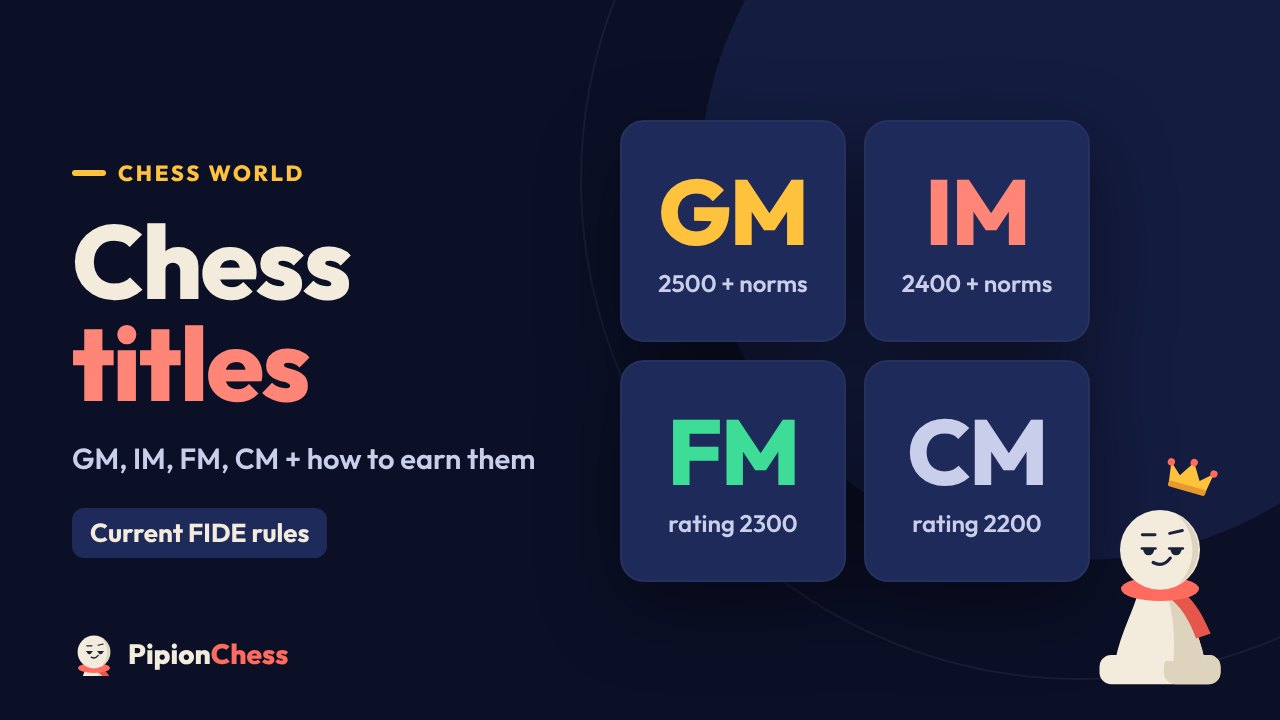
FIDE ratings are also the gateway to titles: CM at 2200, FM at 2300, IM at 2400 (plus norms) and GM at 2500 (plus norms). Every title is explained in Chess Titles Explained: GM, IM, FM, CM and How to Earn Them.
Want to sharpen up every day? Try the daily chess puzzle. It has its own practice rating too.
Sources: FIDE Handbook, Rating Regulations (effective 1 March 2024, including the 400-point rule change of 1 October 2025); FIDE announcement on the 1400 rating floor; Lichess rating systems page.
Frequently asked questions
What is an Elo rating in chess?
An Elo rating is a number that measures a chess player's relative strength. It was created by Arpad Elo and has been used by FIDE since 1970. Your rating goes up when you do better than expected and down when you do worse.
What is a beginner's FIDE rating?
The lowest rating FIDE publishes is 1400, so players below that level do not appear on the list. Newly rated players usually start somewhere between 1400 and the low 1600s.
How do I get a FIDE rating?
Get a FIDE ID through your national federation, then play standard (classical) tournaments that are FIDE-rated. Once you have at least 5 games against rated opponents with a good enough result, your first rating appears on FIDE's monthly list.
Is a chess.com rating the same as a FIDE rating?
No. Chess.com uses the Glicko system and Lichess uses Glicko-2, each with a different player pool. The numbers cannot be converted directly into a FIDE rating.
What rating do you need for a chess title?
CM needs a FIDE rating of 2200, FM 2300, IM 2400 plus norms, and GM 2500 plus norms. The full list is in our chess titles guide.