On this page
Key takeaways
- Chess has six kinds of pieces. Each side starts with 16: eight pawns, two rooks, two knights, two bishops, one queen, and one king.
- Pawns move forward but capture diagonally. Rooks move in straight lines, bishops diagonally, and the queen does both.
- The knight moves in an L shape and is the only piece that can jump over other pieces.
- Point values: pawn 1, knight 3, bishop 3, rook 5, queen 9. The king has no value because losing it ends the game.
Chess has six kinds of pieces. One of them can jump over everything. One of them can never be captured. And one of them is worth exactly one point. In this guide you will learn how every piece moves, how it captures, and what it is worth.
Every diagram shows the squares a piece can reach as green dots. Some diagrams also have a ▶ button to play the moves.
Setting up the board
The board has 64 squares, eight by eight. Each side starts with 16 pieces: eight pawns, two rooks, two knights, two bishops, one queen, and one king. White always moves first.







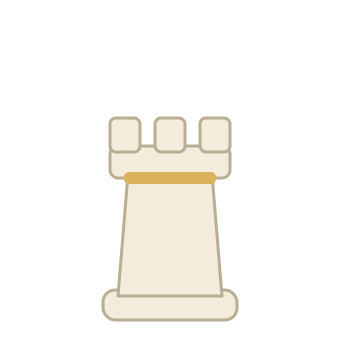

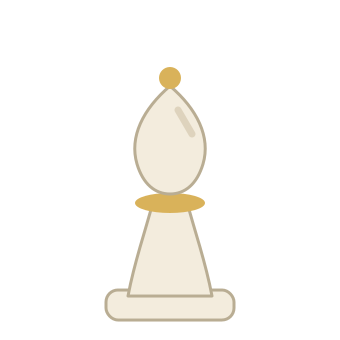
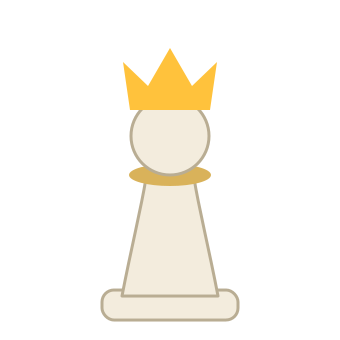

Setting up takes about ten seconds:
- Turn the board so the bottom-right square is light. Remember: light on the right.
- Put the rooks in the corners, the knights next to them, and the bishops next to the knights.
- Put the queen on her own color: the white queen on d1 (a light square), the black queen on d8 (a dark square).
- The king takes the last square in the middle.
- Fill the row in front with pawns.
Pawns fill the front row. Like interns. They do the most work, get the least credit, and still dream of a promotion.
The pawn (1 point)
The pawn moves one square forward. On its very first move, it may move two squares. It never moves backwards.
Here is the twist: a pawn captures diagonally, one square forward. A piece standing directly in front of it blocks it completely: the pawn can neither move nor capture straight ahead.
1.
Two special pawn rules:
- Promotion: a pawn that reaches the far side of the board becomes a queen, rook, bishop, or knight (usually a queen).
- En passant: a special pawn capture, explained in 7 chess moves that look illegal.
 Short · 0:47 · 166 viewsThe Pawn's First Day at WorkWatch the Short →
The rook (5 points)
The rook moves in straight lines: forward, backward, left, or right, as far as it likes. It cannot jump. If its own piece is in the way, it stops in front of it. If an enemy piece is in the way, it can capture it.
Rooks start in the corners and become strong once the board opens up. Two rooks working together can checkmate a king on their own.
The bishop (3 points)
The bishop moves diagonally, any distance, as long as the path is clear.
A bishop that starts on a light square stays on light squares forever, and the other bishop lives on the dark squares. That is why each side has one of each.
The two bishops will never meet. It is not personal. It is geometry.
The knight (3 points)
The knight is the strange one. It moves in an L shape: two squares in one direction, then one square to the side. It is the only piece that can jump over other pieces.
Two more knight facts:
- Every time a knight moves, it lands on the opposite color: light, dark, light, dark.
- Knights are strongest in the center. From the middle a knight reaches eight squares, from a corner only two. Chess players say: a knight on the rim is dim.
 Short · 0:44 · 224 viewsThe Knight Is the Only Piece That Can JumpWatch the Short →
The queen (9 points)
The queen moves like a rook and a bishop combined: straight lines and diagonals, any distance. That makes her the most powerful piece on the board.
Beginners love bringing the queen out early. Their opponents love that too, because an early queen becomes an easy target that can be chased around while the other pieces develop.
The king (priceless)
The king moves one square in any direction. That is it. It is slow, but it is the entire point of the game.
Two important king rules:
- The king can never move into check. That also means the two kings can never stand next to each other.
- The king is never actually captured. When it is attacked and cannot escape, that is checkmate, and the game is over.
The king also has one special move, castling, explained in 7 chess moves that look illegal.
How much is each piece worth?
| Piece | Moves | Value |
|---|---|---|
| Pawn | Forward 1 (2 on the first move), captures diagonally | 1 |
| Knight | L shape, can jump | 3 |
| Bishop | Diagonally, any distance | 3 |
| Rook | Straight lines, any distance | 5 |
| Queen | Straight lines and diagonals, any distance | 9 |
| King | One square in any direction | Priceless |
These numbers help you decide whether a trade is good. Giving up your knight (3) to take a rook (5) wins you two points. Giving up your rook for a knight is a two-point gift to your opponent.
Knight for a rook? Good trade. Rook for a knight? I will pretend I did not see that.
Three beginner mix-ups to avoid
- Walking your king next to the enemy king. That move is illegal, because your king would be in check.
- Thinking a piece is safe behind a wall of pawns. The knight does not care about walls.
- Trading a rook for a knight because both look important. The rook is worth 5, the knight 3.
 Short · 0:31 · 1.2K viewsWhich Piece Can Take the Pawn? You Have 3 SecondsWatch the Short →
Now that you know how the pieces move, put it to work with today’s chess puzzle. One new position every day, from easy to hard.
Frequently asked questions
Which chess piece is the most powerful?
The queen. She moves any distance in straight lines and diagonals, which makes her worth about nine points, more than any other piece.
Which chess piece can jump over other pieces?
Only the knight. It moves in an L shape, two squares in one direction and one to the side, and ignores any pieces in between.
Can a pawn move backwards?
No. A pawn only moves forward. It moves one square at a time, or two squares on its very first move, and captures one square diagonally forward.
Where does the queen go when setting up the board?
On her own color: the white queen starts on d1, a light square, and the black queen on d8, a dark square. The king takes the square next to her.
Can the king be captured?
No. When the king is attacked and has no way to escape, that is checkmate and the game ends before the king is ever taken.